MSU Homecoming Court members pursue Undergraduate Research
The Michigan State University Alumni Office announced the 2026 Homecoming Court on August 26, recognizing twelve students who embody Spartan values through their scholastic activity, advocacy, and leadership. These homecoming court members serve as ambassadors, representing MSU at university, alumni, and community events.
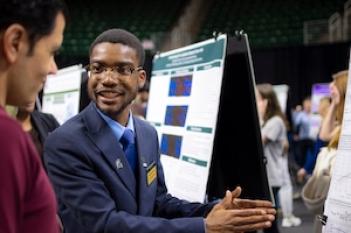
Many of these student leaders have participated in undergraduate research. Of the twelve members of the homecoming court, seven have participated in research activities run by the MSU Undergraduate Research Office; six presented at the University Undergraduate Research and Arts Forum (UURAF) in 2026 and two participated in Pathway to Research (PTR).
While their research areas, journeys, and lives may be different, they can all agree that undergraduate research has helped them become the person they are today.
Senior English and sociology major Roberto Marcos Garcia first got into research through a class requirement, choosing to focus on Latino voting trends and the social factors that influence these decisions. Undergraduate research was the catalyst for Garcia to consider what he was passionate about.
“Getting that experience of researching during my undergrad has been really transformational for me,” Garcia said. “It’s helped me clarify what I like to do.”
Research has been a fixture of senior kinesiology major Jagger Wraalstad’s undergraduate experience, having presented a total of eleven times at different conferences and events.
“My research experiences have significantly shaped my future plans and myself in general,” Wraalstad said. “I feel I hold myself better in professional settings because of my experiences presenting research.”
Senior strategic communication and public relations major Katie Goble is the first community college transfer and the first student not at MSU for all four years to be on Homecoming Court.
“I had such a zig-zaggy path to get to where I am today,” Goble said. “It is weird to think about how I started on such a different path, but it brought me to something beautiful.”
To get to where she is today, Goble participated in Pathway to Research (PTR) run by the Undergraduate Research Office.
“I would advise students to join PTR,” Goble said. “That program helped me narrow down my interests, find faculty who are currently conducting research and have open positions, and understand the benefits of UR before beginning a research position.”
Senior economics major Sumaiya Imad’s experience with undergraduate research is all about helping women from her home country of Bangladesh. For Imad, presenting at UURAF was not about winning, but about sharing the work she is passionate about.
“This work is very important to me,” Imad said. “I have poured six or seven years of my life into working with these women. It’s important for me to translate their stories into all the work that I do going forth. Through UURAF, I’m able to embody that and share it.”
Biochemistry senior Benjamin Nketsiah’s research is also informed by his home country of Ghana. An internship at Henry Ford Health made him realize his research area of breast cancer was not only a medical problem, but an “ethnicity problem.” Through continued research, he has found higher rates of breast cancer among people of West African descent.
While most of Nketsiah’s research has focused on medicine and health care, his work and interests span a diverse range of topics and mediums. He had an article published in SPARC, MSU’s student-led research journal, on philosophy and theology.
Nketsiah and Garcia emphasized that students should participate in undergraduate research no matter what they study or what their academic plan is.
“It doesn’t matter what field you’re in; you can find research to do in it,” Garcia said. “That’s pretty motivational. Sometimes that’s kind of revolutionary for people...There is always research to be done because nothing is fully known.”
Nketsiah said research has helped him look at problems in a different way than he does in everyday life and become humbler in his claims. The skills students gain doing research in their undergraduate years can transfer into daily problem-solving and social skills.
While UURAF was his first presentation, Nketisah has gone on to present in San Francisco at an international conference. He said the most important thing about presenting is growing confidence, getting feedback to use within his work going forward, and learning to effectively communicate his ideas.
“Science which is communicated has impact beyond science which is not communicated,” Nketsiah said.
Neuroscience senior Shrinidhi Pola has researched neuroscience through music and the concept of grooving. Pola said undergraduate research was the opportunity she was most grateful to be involved in at MSU, giving her not only experience and expertise, but “soft skills” like working with a variety of people and communicating her ideas.
“There’s no point unless you’re able to talk about what you’ve learned,” Pola said.
Written by Genevieve Henry