A Spartan Voice for Women in Bangladesh
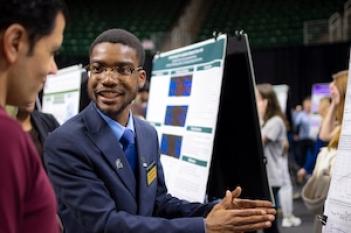
The Undergraduate Research Office at Michigan State University provides students with opportunities to develop and present their research and attain research positions. For most students, the annual University Undergrad Research and Arts Forum is a chance to develop their research skills, practice presenting, and compete for awards.
For Sumaiya Imad, a senior studying economics, it’s not about winning. It’s about sharing her passion and raising awareness.
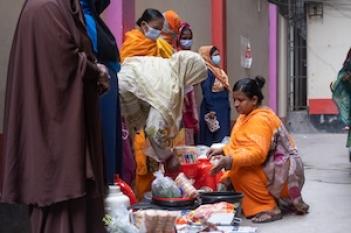
Imad, from Bangladesh, started a non-profit when she was in high school to help women who have been victims of human trafficking. She helps them get vocational training and seed funding to start small businesses so they can pay out of their bondage. After these women are free, Imad’s nonprofit works with mental health specialists to make sure they can recover from their trauma. She has aided over 100 women from her home country.
Imad was attracted to MSU for its focus on research and mentorship during undergraduate studies.
“I knew that MSU would be the place where I could not only integrate the academics but also go out of my way to build a thesis statement, get a capstone done, and get funding for my research,” Imad said.
In her sophomore year, Imad was awarded the Tomlanovich-Dimond Leadership Research Advancement Fund through the Women’s Leadership Institute. It enabled her to do field research and conduct interviews with women in Bangladesh, because she found there was not enough pre-existing research in her area to continue her work.
“A lot of the women I have worked with who were trafficked end up going back to sex work, not because they want to, but because they don’t have the means to sustain life outside of it,” Imad said. “A big part of that is weak laws. Through my research, I was able to come to the conclusion that there is a significant gap between the laws that are in place and the way they are implemented.”
“It was very eye-opening for me,” Imad said. “It was important for me in the trajectory of my life, being able to recognize that the legal path was a more sustainable path for me to go into if I wanted to help these women.”
Imad has presented her research on this topic at UURAF three times. She won it in her sophomore year and twice in her junior year.
“This work is very important to me,” Imad said. “I’ve poured six or seven years of my life into working with these women. It’s important for me to translate their stories into all the work that I do going forward. Through UURAF, I’m able to embody that and share it.”
For many students presenting at UURAF, communicating their research is just an academic goal. Imad said she needs to present her work to help the women she has worked with. UURAF is a valuable tool for her to share what she has learned.
"I want you to understand there are women on the other side of the world that are struggling to stay alive,” Imad said. “I want you to know that you can help me. The minimum you can do is at least learn about it. A lot of people don’t even know where Bangladesh is.”
Imad was selected to be a part of MSU’s homecoming court for her final year. She is the first Bangladeshi to be selected.
“All the support I got during my undergraduate years really proved to me what it means to be a Spartan,” Imad said. “I wanted to embody that and represent all the effort, kindness, and love I was shown throughout my journey.”
By Genevieve Henry